In this article, Doherty Nutrition explores the DGAs by reviewing their purpose and history, outlining what has remained consistent over time, and highlighting key updates in the 2025-2030 edition. A dietitian’s perspective is also included to help interpret how these recommendations may be applied in real-world settings.
What are the Dietary Guidelines for Americans?
The DGAs are a set of evidence-based nutrition recommendations developed jointly by the U.S. Department of Agriculture (USDA) and the Department of Health and Human Services (HHS). Updated every five years, the guidelines are designed to promote health, prevent chronic disease, and support healthy eating patterns across the population.
Serving as the foundation for federally funded nutrition programs like the National School Lunch Program, Women, Infants, and Children (WIC), and the Supplemental Nutrition Assistance Program (SNAP), the DGAs also inform nutrition education, clinical practice, and public health initiatives. Because of their broad reach, each new edition often prompts discussion among nutrition professionals and public health experts, with Registered Dietitians referencing the guidelines to translate the latest scientific evidence into guidance designed to support overall health and reduce chronic disease risk at the population level.
The History of the DGAs
Dietary guidance in the U.S. dates back over a century, when early recommendations were significantly influenced by world wars. Advice prioritized conserving food, preventing waste, and avoiding nutrient deficiencies. As nutrition research advanced, these guidelines evolved to reflect the latest scientific evidence.
The modern Dietary Guidelines were established in 1980, after earlier dietary goals were criticized for lacking a solid evidence base. In response, the U.S. Department of Agriculture (USDA) and the Department of Health and Human Services (HHS) partnered to create a unified, science-based framework for national nutrition guidance.
In 1983, as a result of needing adequate evidence, the Dietary Guidelines Advisory Committee (DGAC) was born. This team of nutrition and public health experts reviews current research and provides recommendations for each new edition, which the USDA and HHS then publish every five years.
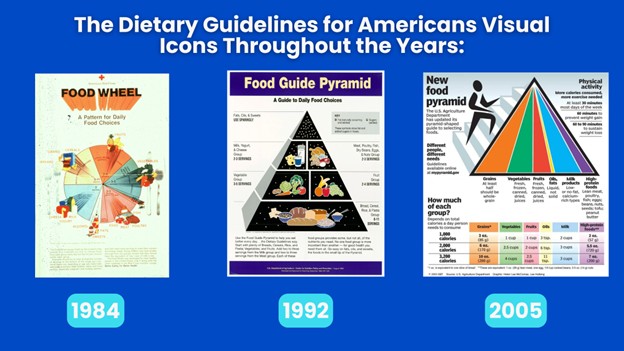
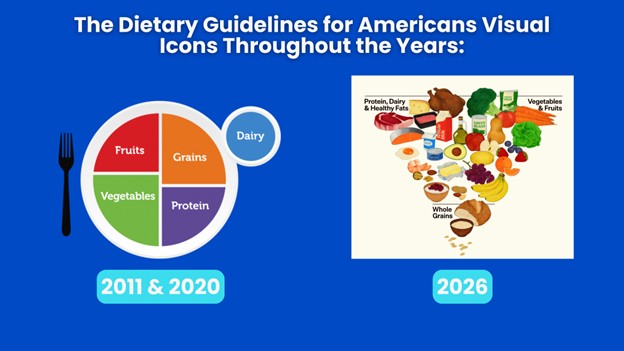
Visual guides have accompanied the DGAs to help people understand healthy eating patterns. The 1984 Food Wheel illustrated five food groups (grains and cereals, fruits and vegetables, protein rich foods, fats, and), which evolved into the Food Pyramid in 1992. In 2011, MyPlate replaced the pyramid, showing a balanced meal on a plate to make portioning more intuitive. Flash forward to 2026, the pyramid is back, inverted and rebranded, paired with the current administration’s message to “Eat Real Food.”
The Updated Dietary Guidelines for Americans
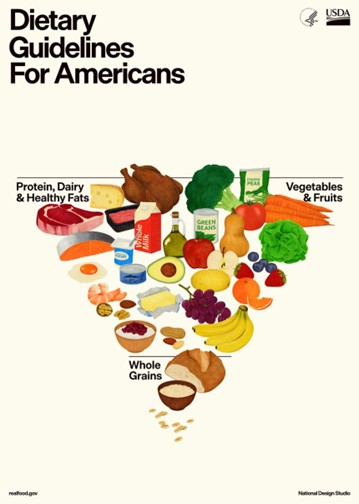
The 2025-2030 Dietary Guidelines introduce several notable updates. At first glance, proteins, dairy, and vegetables are at the forefront, followed by plant-based proteins like beans, legumes, and nuts. Meanwhile, whole grains are placed narrowly at the bottom.
Additional updates from the recent DGAs include:
A stronger emphasis on whole foods and firm recommendations to limit ultra-processed foods.
Protein recommendations have increased from 0.8 g/kg to 1.2-1.6 g/kg of body weight for adults. The previous recommendation was based on the Recommended Dietary Allowance (RDA), which is based on preventing deficiency, not optimal health. Protein needs continue to vary based on age, activity level, and health status.
A strong emphasis is placed on animal proteins and whole-fat dairy products.
Added sugars are now limited to 10 grams per meal. Updated guidelines state that no added sugars or non-nutritive sweeteners are recommended.
A statement on improving gut health by increasing fiber intake is included.
The updated visual returns to a pyramid, prioritizing animal-based proteins and vegetables as the base of the diet and whole grains at the narrow point.
What’s Consistent in the Dietary Guidelines for Americans?
Since their official release in 1980, the DGAs have consistently emphasized:
Fruits and vegetables
Protein from both animal and plant sources
Whole grains, lentils, and legumes
Healthy, unsaturated fats
Limit added sugars, sodium (up to 2,300 mg), and saturated fat (10% of daily intake) to their recommended amounts.
Beyond the core food groups, other principles have remained consistent across editions:
Balance and variety matter, no single food or nutrient is the key to health.
Portion awareness remains important, even when focusing on nutrient-dense foods.
Lifestyle factors beyond food such as physical activity, sleep, and stress management remain crucial to overall health.
Nutrition through the lifecycle is differentiated with specific recommendations for all life stages, from infancy to adulthood to the elder years.
Whether it’s depicted via the food wheel, food pyramid, or MyPlate, whole foods have always been the center of the conversation.
Our Take on What’s Inconsistent in the New DGAs:
While the 2025-2030 Dietary Guidelines maintain many long-standing recommendations, certain elements may create confusion for both professionals and the public. The most common critiques of the new DGAs target contradictory messaging.
Saturated Fat
The guidelines encourage foods like whole-fat dairy, red meat and beef tallow, all higher in saturated fat content, while still recommending that saturated fat remain below 10% of daily calories.
If an individual were to regularly include these foods in their diet, it would be difficult to keep saturated fat intake below 10% of total calories. For example, someone following a 2000 calorie diet would be recommended to consume less than 22 grams of saturated fat per day. Consuming foods encouraged in the pyramid – such as 2 cups of whole milk (~10g saturated fat), 1 cup of full-fat yogurt (~5g saturated fat), and a 4oz serving of ground beef (~6g saturated fat) – brings the daily total to around 21 grams, leaving little to no room throughout the rest of the day for other meals and snacks. This creates a practical inconsistency between the visual guide and written instructions.
Carbohydrates
Although low-carb diets are not explicitly endorsed, some readers may interpret the placement of whole grains and refined carbohydrates as a signal that limiting carbs is advised.
Nutrition science consistently supports including complex, whole grain sources of carbohydrates to provide the brain and body with a stable supply of glucose, our preferred source of energy. Unnecessarily limiting carbohydrates sets individuals up for low energy, brain fog, increased cravings, and can possibly lead to binge-eating tendencies.
Restricting entire food groups does more harm than good. And while recommendations don’t state to remove carbohydrates, the visual implication of grains being at the point of the pyramid can be interpreted otherwise.
Alcohol
The new DGAs recommend “consume less” alcohol. This recommendation is markedly different from the 2020-2025 recommendations which suggested less than 1 drink per day for women and less than 2 drinks per day for men.
The USDA and HHS have a dual responsibility to support both the American economy and the health of the American people. The World Health Organization emphasizes that no level of alcohol consumption is entirely safe. While alcoholic beverages contribute to economic spending, the administration describing alcohol as a “social lubricant” while demonizing the added sugars in birthday cake raises concerns about what is being prioritized when creating public health guidelines.
These inconsistencies make it challenging to apply the guidelines in practice. As dietitians, we recognize that while the DGAs provide a strong evidence-based foundation, real-world interpretation requires nuance and consideration of individual circumstances, cultural preferences, and access to foods.
Dietitian’s Interpretations
At First Glance
The return of a food pyramid makes a visually striking headline, but dietitians have not used the pyramid as a teaching tool since 2011. Many RDs welcome the focus on whole foods as they tend to be more nutrient-dense, satiating, and can help prevent chronic diseasecognizing these benefits does not require the demonization of processed foods since practical barriers like time, finances, and access remain significant for many Americans.
Population Context
Approximately 13% of Americans experience food insecurity, and roughly 1 in 10 lack health insurance, highlighting ongoing challenges in population health. Practical barriers such as limited access to healthy foods, healthcare constraints, and gaps in nutrition education mean that the DGAs cannot serve as a one-size-fits-all solution. Considering these factors is essential when interpreting how the guidelines can be applied in real-world settings.
Protein and Fiber for the Win
The updated protein recommendation of 1.2-1.6 g/kg per day supports lean muscle, satiety, and blood sugar regulation. Emphasizing animal-based proteins and whole-fat dairy also reflects the fact that certain nutrients, such as vitamin B12, iron, zinc, choline, DHA/EPA and creatine, are more easily obtained from animal sources.
At the same time, fiber intake remains a critical gap. Only about 10% of Americans meet recommended levels. This highlights that both adequate protein and fiber-rich foods are important for overall health. Our approach is to include protein in moderation while intentionally incorporating fiber-rich fruits, vegetables, whole grains, and legumes to support gut and metabolic health.
Context Matters
Food choices are shaped by accessibility, affordability, and individual circumstances. The DGAs provide a strong evidence-based framework, but thoughtful interpretation is required to apply them to diverse eating patterns. No single guideline can account for every lifestyle, preference, or cultural context, which is why dietitians translate the recommendations into personalized guidance that works for individuals.
Closing Thoughts
The 2025-2030 Dietary Guidelines for Americans reflect a growing emphasis on whole foods, protein adequacy, and metabolic health. Both protein and fiber-rich foods are essential components of a healthy diet, supporting muscle, satiety, gut health, and long-term disease prevention.
While the DGAs provide a strong evidence-based framework, they are not one-size-fits-all. Individual circumstances, access, preferences, and cultural considerations all play a role in how the guidelines can be applied. Thoughtful interpretation guided by a Registered Dietitian can help translate the recommendations into practical strategies for everyday eating.
Ultimately, the DGAs are a tool to guide healthier choices. However, achieving balance, variety, and nutrient adequacy requires adapting guidelines to real-life contexts. For help personalizing nutrition recommendations and applying dietary recommendations, schedule an individual appointment with one of our Registered Dietitians to discuss how you can better improve your overall health with food.
Doherty Nutrition is a participant in the Amazon Services LLC Associates Program, an affiliate advertising program designed to provide a way for websites to earn advertising revenues by advertising and linking to Amazon.com.